Seamless replacement
Directly replaces sodium cyanide without changing the original cyanidation process or the main equipment configuration, making field adoption simpler and faster.
 GCG Mining Services
Mining Chemicals, Plant Solutions, Global Supply
GCG Mining Services
Mining Chemicals, Plant Solutions, Global Supply
Eco Gold Reagent
Our eco gold leaching reagent is engineered for gold projects that need a lower-risk, lower-toxicity leaching route without rebuilding the current cyanidation circuit. It can directly replace sodium cyanide in the original process flow and equipment framework while maintaining strong recovery performance and easier environmental positioning.
Technical Advantages
This product is not positioned as a conceptual alternative. It is built for operating mines that need smoother adoption, stronger environmental control, and stable recovery economics under real plant conditions.
Directly replaces sodium cyanide without changing the original cyanidation process or the main equipment configuration, making field adoption simpler and faster.
Addresses toxicity at the molecular level and supports lower-toxicity tailings discharge, helping protect mine-site ecology from the source.
Leaching rate can exceed 90%, with fast recovery response and relatively low dosage, helping projects maintain both process rhythm and commercial performance.
Exported to more than 30 countries and used by 500+ medium and large clients across oxide ore, primary ore, and high-sulfur or high-arsenic gold ore conditions.
Why Replace Cyanide
Around the world, mine operators face tighter control over highly toxic chemicals in procurement, transportation, storage, site handling, environmental review, and community communication. The real question is not whether to change for the sake of change. It is whether a safer route can be introduced without disrupting production or sacrificing commercial viability.
That is where this reagent becomes relevant. It offers a technically workable path for projects that need to retain the original cyanidation logic while reducing toxic-risk pressure and improving the project's environmental narrative.
| Item | Eco Gold Reagent | Sodium Cyanide |
|---|---|---|
| Process adaptation | Direct replacement in existing cyanidation flow | Conventional baseline route |
| Adoption threshold | Low, suitable for sample and scale-up evaluation | Technically mature but under higher regulatory pressure |
| Toxicity and environmental profile | Low-toxicity and more eco-oriented | Highly toxic and tightly regulated |
| Transport and storage pressure | Lower pressure | Higher control requirement |
| Site handling risk | Lower | Higher |
| Leaching performance | Leaching rate can exceed 90% | Traditional reference solution |
| External project communication | More helpful for environmental positioning | More likely to trigger environmental concern |
Case Validation
Adoption decisions should be supported by site evidence. The following cases show how JINCHAN performed in both CIP and heap leaching conditions, including process parameters, reagent consumption, and recovery outcomes.
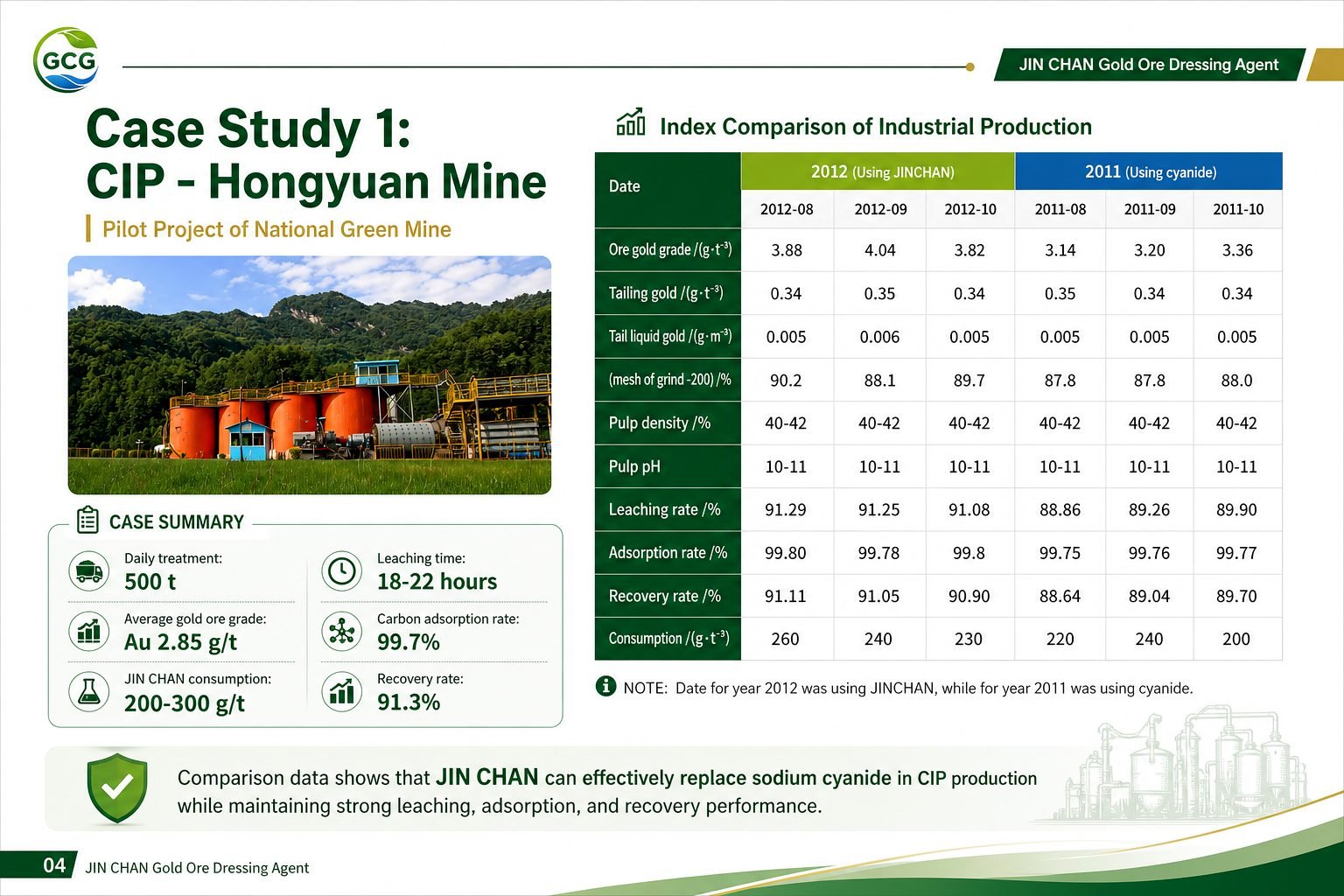
This manual page shows a full industrial comparison between JINCHAN and cyanide in CIP production, including ore grade, pulp conditions, leaching rate, adsorption rate, recovery rate, and reagent consumption.
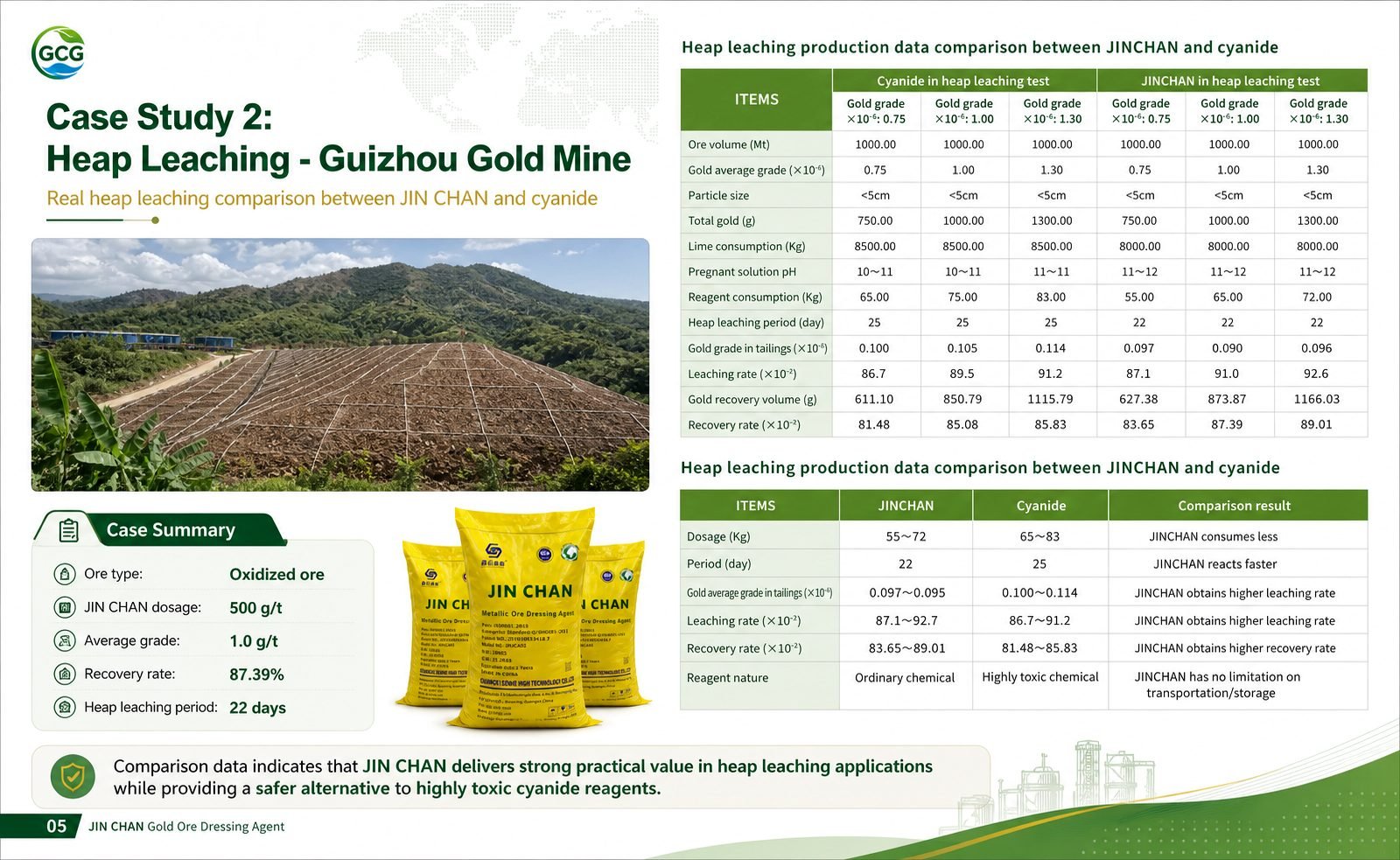
This manual page presents heap leaching comparison data covering dosage, period, tailings grade, leaching rate, recovery rate, and transport or storage advantages under oxidized ore conditions.
Supply and Trust
Technical performance matters, but clients also want evidence that supply is stable, packaging is export-ready, and factory access is real. JINCHAN has been exported to more than 30 countries and supplied to 500+ medium and large mining clients, backed by visible warehousing, finished product stock, and customer visit records. We also support ore sample testing and can adjust the product route based on testing data to help clients reach a better leaching result.
Technical Inquiry
If you are assessing a cyanide replacement route, share your ore type, average grade, current process, treatment capacity, target recovery, and the main constraints your project is facing. We can then discuss sample testing, technical documentation, dosage reference, and the next supply step in a more practical way.
